When Weitblick met Stockholm (1)

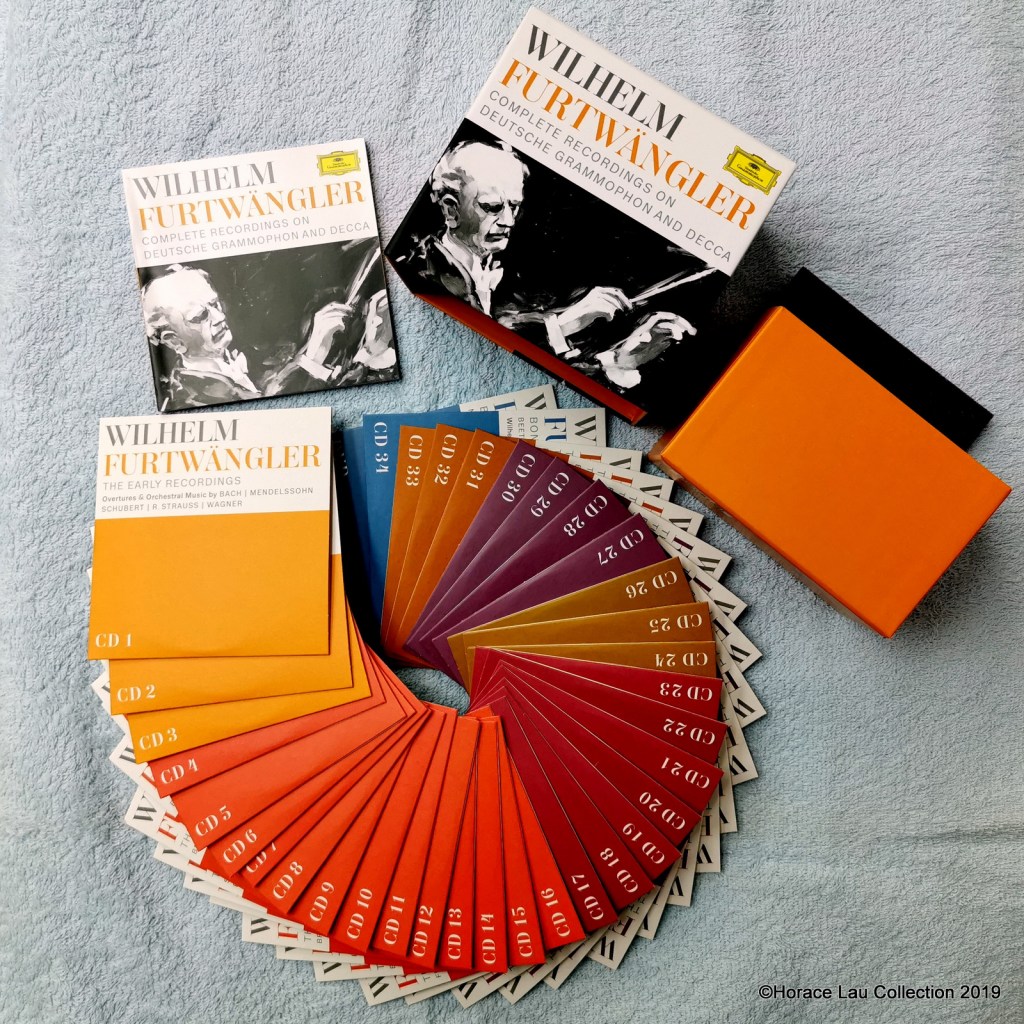
Given the intense interest in reissuing anything Furtwängler in the past three decades, it is almost inconceivable that all his recordings with the Stockholm Philharmonic were only grouped together in a box set in 2019. All of these recordings have been issued before, albeit in a piecemeal manner. Even the concert on 13 November 1948 has not been released commercially in one single package. That 1993 Music and Arts CD (CD793) was almost there when it included the Beethoven 7 and 8, but the Leonore Overture No. 3 was missing. Interestingly, only the rehearsal on the previous day was included.

CDs containing the recordings in this new Weitblick set, with the exception of Beethoven 8, were not commonly reissued previously, and this fact will make this new set appealing to some fans of the conductor.

First of all, let me say that the quality of sound in all these recordings is very much a case of caveat emptor. Strictly speaking, there were no original master tapes to speak of, because all of them were originally recorded on acetate discs. As such, don’t expect miracles in sound even if Weitblick claims that some of the recordings are firsts from Swedish Radio sources, namely Beethoven 7 and 9, Richard Strauss’ Don Juan and Wagner’s Tristan und Isolde excerpts.

This 4-CD set contains a passionately-written essay by Néstor Castiglione. A very fine read I’d say, much better than those by Norman Lebrecht who seemingly can only write on Furtwängler in a denigrating tone one way or another.

The old warhorse re-appears: Stockholm Beethoven 8

This 1948 Beethoven Eighth recording is one of the two recordings, the other being the Second, that allowed EMI to issue a complete Furtwängler Beethoven symphony set after Furtwängler had died before the project to record all Beethoven symphonies with the Wiener Philharmoniker could be finished. It has been issued with different remastering by EMI, and lately by Warner, many times previously. So it is no stranger to music lovers.

In this performance, Furtwängler deftly depicted all the contrasts designed by Beethoven in this symphony while allowing sunshine to stream in the music. The orchestral sonority of the Stockholm Philharmonic was admirable, and did not sound distinctly different from the BPO or even the VPO.

In the second movement (Allegro scherzando), I can exclaim, “What rhythmic beauty!” The repeated staccato woodwind chords and the answering bass-line together painted a soundscape full of ebullience. In the third movement in Tempo di menuetto I can sense a very elegant dance. However, unfortunately there was some untidy playing in the Finale.
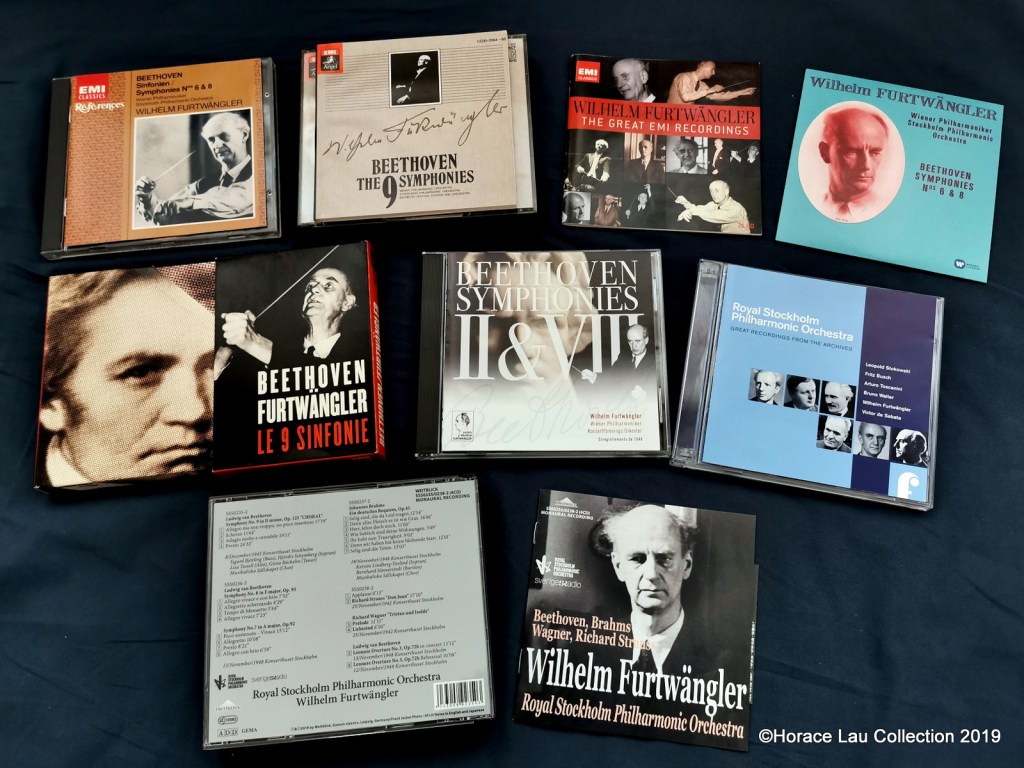
EMI, now Warner, has seen many competitors in this recording. Its own version in its latest remastering should be familiar to many of us. It has a compressed dynamic compared to others, with thinner sound too. The Music and Arts CD has added excessive echo that I’m not keen on. The French Furtwängler Society CD obviously employs less noise reduction, with better dynamic compared to EMI’s, but it is lighter in bass. The CD in the Royal Stockholm Philharmonic Orchestra commemorative set has a sound which is more lively and full-bodied. The newcomer from Weitblick, fortunately, has a definitely better sound and dynamic. I’d say it is even better than the previous champion in the Orchestra’s set.

The Bruckner collection in the new DG box set (2)

The unique Bruckner 9

“How unique is this recording?” One may ask.

It is the only extant Furtwängler’s Bruckner 9 recording available to us at present. One amazing thing about this recording is that it has long been thought to be a live recording of a performance on 7 October 1944 for broadcast purposes. However, new evidence shows that it was in fact a “studio” recording made over 5 days from 3 October to 7 October. This finding challenges our long-held conception of the demarcation between live and studio recordings by Furtwängler.

Philippe Leduc, of the French Furtwängler Society, has described this Bruckner 9 as “one of the most beautiful performances in history”. As such, ever since Deutsche Grammophon first issued this recording on LP in 1963, DG has reissued it on CD a few times, and other companies or societies have also reissued it using different sound sources.

From the DG camp, the first reissue on CD was from Japan in 1991 (POCG-2347), and then in 1994 within the large 34-CD set (POCG-9491). Around the same time, Polygram France reissued it on a double-CD (coupled with Bruckner 7) which was also available outside France. We have to wait till 2004 for the official international release, which is included in the 6-CD box set Wilhelm Furtwängler – An Anniversary Tribute, marking the 50th anniversary of Furtwängler’s death. Fifteen years later today, it is again included in the new box set which marks the 65th anniversary of his death.

There are many releases from other companies, and I can include only a few common or salient ones for comparison here.

1996 Dante LYS 110

2004 French Furtwängler Society SWF 041

2008 Music & Arts CD-1209 (within this 5-CD set of Bruckner symphonies)

2017 Praga Digitals PRD/DSD 350125 (hybrid SACD)

2018 Berliner Philharmoniker (in the 22-hybrid SACD set of wartime recordings)

Before comparisons are made, we need to know what primary sound sources are available. Unfortunately, the master tape has not been found so far. This recording was not included either in the batch of half-speed copy tapes returned from the former USSR in 1987 or in the master tapes in 1991. However there exist several copy tapes of the original master tapes in:

  • Deutscher Demokratischer Rundfunk Berlin (hence the Eterna LPs)
  • Bayerischer Rundfunk Munich
  • Deutsches Rundfunkarchiv (DRA)
  • Funkhaus Berlin (an incomplete copy)

The first DG release in 1963 was based on the copy tape from the former DDR, and subsequent DG reissues were also based on it or the copy tape in Munich licensed from the former Deutscher Demokratischer Rundfunk Berlin.

New vs Old DG’s

The sound of the CD in the new set is very similar, if not identical, to that in the 2004 Anniversary box set. The French release in 1994 was slightly drier and slightly boxier. The Japanese releases do not have the usually anticipated superiority. In short, the sound of the new reissue is very satisfactory to me.

DG vs others

The sound source of the Dante CD is not specified and is assumed to be from a DG LP. The sound is warm and gentle, but is muddier at the same time. Those who prefer a softer sound may like it. The French Society CD was claimed to have better dynamics, but to my wooden ears, the difference to DG’s is quite minimal. The tape hiss is more pronounced though.

The M&A reissue again did not specify its sound source, only saying the recordings are digitally remastered with the “revolutionary harmonic balancing technique”. Noise reduction is heavier and there is a hint of added echoes or reverberations. The timbre of the instruments is duller than that in the DG set.

Are the SACDs better? The Praga hybrid SACD has a higher level with a ”high-definition” inclination. I suspect it is just a digital upscaling of the digital file from a DG CD. As such, the tape hiss becomes intrusive in softer passages of music, and the sound is thinner. The sound of the DG CD is more natural. The remastering in the Berliner Philharmoniker hybrid SACD results in a slightly better sound, but not much. There is less tape hiss, but the trenchant sound is not to everyone’s liking. The slight distortion in the first tutti of the opening movement is still there, for example. I still prefer the more natural timbre of the brass and the more passionate-sounding woodwind in the DG CD.

Sound is no replacement of the performance

I’m rather sceptical of a current trend, especially in Japanese companies, of pursuing, or at least claiming, a better sound in a particular Furtwängler recording in endless reissues. If a new reissue is based on a better primary sound source, e.g. a newly discovered master or copy tape, e.g. the RIAS recordings from Audite, then it is more meaningful. If it is only just another “new remastering” from a secondary sound source, e.g. an old LP or the trendy 2-tract tapes, then it is little more than the emperor’s new clothes.

For many “new remastering” in recent years, the attention to improving each small passage of sound in the recording often results in losing a natural progression of the music which is very much the treasurable attribute in the performance captured in the original mastering of the past. In other words, many new remastering attempts have missed the wood for the trees.

For this particular Bruckner 9 in particular, when I listen to such a moving rendition and the music itself has attracted all my attention, any differences in the quality of sound becomes imperceptible and indeed irrelevant. The music itself is all that is important, isn’t it?

The Bruckner collection in the new DG box set (1)

Overview

One of the highlights in the new Wilhelm Furtwängler – Complete Recordings on Deutsche Grammophon and Decca box set is its excellent collection of Bruckner recordings within Furtwängler’s discography.

There are extant recordings of the last six Bruckner symphonies conducted by Furtwängler.

For the Fourth Symphony, there exists a 1941 performance but it is not complete and is in very poor sound. The other two post-war recordings, both in 1951 and by the VPO, are included within this new set. The earlier recording in Stuttgart was released by DG while that performed one week later was by Decca.

There exist two Bruckner 5’s. The magnificent wartime concert in 1942 is included here. The other one was in Salzburg in 1951, previously released by EMI.

The only extant Sixth is that of a wartime concert in 1943 but unfortunately the first movement is not available, whether it was not recorded or has been lost is not clear. It is not included in this new DG set.

Five recordings exist for Bruckner 7. The wartime one in 1941 suffers the same fate as the wartime Fourth, incomplete and in poor sound. There is a studio recording in 1942 of only the Adagio by Telefunken. Then there are three post-war recordings available. The 1949 performance was issued by EMI. The other two are from 1951. The earlier one in Cairo was first released by DG in 1976 on LP and is included here. The later one in Rome has been released by Tahra. These three post-war performances are quite similar, although many prefer the 1949 one.

When it comes to Bruckner 8, the wartime Magnetofonkonzert in 1944 is considered the best among Furtwängler’s four extant recordings of this symphony, and is fortunately included here. The other three are post-war concerts, less inspired and less angst-ridden than the wartime one.

The only Bruckner 9 performance in Furtwängler’s discography is considered by many as one of the best recordings in history of this symphony. It was first issued by DG in a memorial LP box set in 1963, and is logically included in this new CD set. A recording not to be missed!

The piles of relevant CDs previously released by DG and Decca/London for comparison with the 6 Bruckner CDs included in the new box set

The Decca Bruckner 4

This concert recording was made on 29 October 1951 in the Congress Hall of the Deutsche Museum, Munich. Strangely this Bruckner 4 has not been released on CD by Decca internationally and so it is considered rather rare.

The Japanese CD versions that I have include a 1996 CD released by King Record, “manufactured under license of Polydor K.K.” (KICC 2502), and a 1997 CD released by Polygram K.K. Japan (POCL-4302). The sound of the latter is not good, being dry and thin, compared to the former. The sound of KICC 2502 has an LP-feel, rich with a good bass; the timbre of the Viennese cellos is fuller and mellower in particular.

KICC 2502 on the left and POCL-4302 on the right

Later, in 2002, Orfeo released a double-CD of the concert on 29 October 1951 and also Haydn 88 of a week earlier (C5590221). The sound appears more modern and transparent, but the price to pay is that it becomes dry and the brass loses the mellowness of the VPO. The sort of monopoly by Gottfried Kraus on the remastering of Furtwängler’s VPO recordings has raised a few eyebrows, and I can confess that I’m not one of those who like his particularly sonic signature in these remasterings.

Then Tahra in 2004 included this Bruckner 4 in her 4-CD Wilhelm Furtwängler In Memoriam. The sound is even worse than the Orfeo’s, being aggressively bright and coarse, with the higher notes sounding piercing and shrill, and thus losing the famous Viennese charm of the VPO.

The Orfeo and Tahra releases of this performance

The CD in the new DG set (CD33) has a much better sound than that of Orfeo and Tahra. The sound is a good mix of clarity, fullness and warmth. There is no information given on remastering. The 1996 Japanese CD may sound a little richer but is less clear.

A good start I’d say 🙂